Rogue. I started using a computer when I was three. Back in the 80s this was the exception, not the rule. My parents had a PC Jr, one of the first computers with a monitor that could display any kind of color. My dad taught me how to use MS DOS to access the games on the PC Jr. My favorite of these games was called Rogue.
In Rogue, you played a little adventurer, represented by a tiny smiley face icon. You navigated your adventurer through randomly-generated dungeons; fought monsters, represented by letters of the alphabet (T for Troll, Z for Zombie), all of which had different abilities and strengths; collected gold, potions and equipment; and ate delectable things such as slime mold (viable nutriment in Rogue) to keep your character alive.
I now know that Rogue is considered the first "graphical adventure game" and is kind of a big deal in computer game history. I did not know this when I was three. Mostly I knew that I wanted to get to the fiftieth level of the dungeon and slay the M(inotaur). Because who doesn't want that?
Once, I made it to perhaps the twentieth level, which was a big deal since normally I died every five minutes or so. But it was late and my parents made me go to bed. When I woke up I found that someone had turned the computer off! I wanted to cry. Dejected, I pushed the power button on the CPU. The little indicator light turned off. I pushed it again; the light turned on.
My dad appeared. "Sara!" he said. "I just turned the monitor off! I left the computer on!" And that's how I learned that monitors work separately from the CPU.
Pee-wee's Playhouse. I think this one explains itself.
Dungeons and Dragons. My parents have been playing D&D (and later AD&D) since before I was born. If I recall correctly they started back with the original D&D box set where you had to color in the pips on the dice with a white crayon.
As a small kid I thought all adults played D&D whenever they had friends over for dinner. I always wanted to join in but for the very most part I would just listen on the sidelines until I got bored or confused. It was probably too hard for me to play anyway, at least when I was very small. The game is much simpler now, but Advanced Dungeons and Dragons was a different story, with its THAC0 charts and all its innumerable tables and obscure conditional rules.
The first time I actually played a game of AD&D was when I was seven. My friend Tracy was the DM. I took my fighter through a dungeon and in the deepest depths I fought and killed a white dragon. Righteous.
Later that week I went to a novelty store at the mall and bought a necklace to symbolize this victory. The pendant was a dragon-ish looking claw holding a clear marble. I remember thinking very specifically that the marble was the dead dragon's eye. I wore the shit out of that necklace.
Books. I started reading when I was two. I read all kinds of everything. I especially loved fantasy novels. I read fast and constantly. I read on the playground during recess. (I was not a particularly popular little girl.)
My original job aspirations were astronaut (because space) and author (because books). Then I found out how you use the toilet on a space shuttle and that pretty much killed my space aspirations.
After that I basically assumed I was going to grow up and become a writer. I lost track of that goal for a long time, but I've come back to it as an adult. Even though I'm unpublished I feel I am finally doing my younger self justice.
The kinds of books I read (mostly fantasy) made me want to see things differently. I wanted to look around myself and find secrets and magic. I wanted to believe that there is something more to the world than what is apparent to our eyes and ears.
I still do.
Two books stand out particularly well in my memory. The first is the book pictured above, Wise Child by Monica Furlong. Thinking back, I'm all but sure that this book made me stop being Catholic and turned me into the weird pseudo-pagan-but-not-really I am today. (I identify as Panentheist. Say that five times fast. I'm not Atheist but I'm a-religious.)
The second is Oddly Enough by Bruce Coville, a collection of short stories, one of which ("The Language of Blood") most likely generated my deep and abiding love for vampires.
One does not simply become weird overnight. I have cultivated my taste for the bizarre for my entire life, developing my peculiar and particular sensibilities through the consumption of a wide array of counter-cultural artifacts. This entry is the second in a series cataloging my most beloved of those books, films, television shows, and other forms of media.
Spoilers are happening in this article. FYI.
Okay, so, full disclosure: from seventh to ninthish (perhaps also tenth) grade, I was totally obsessed with Sailor Moon, an extremely (perhaps unreasonably) popular manga and anime series about a slackerish middle school student named Usagi (shown below) who fights monsters from outer space with the help of her talking cat, who is from the moon.
Without delving into a lengthy discussion about the series, let me confirm that the show is pretty much as bizarre as its premise makes it sound. It's ostensibly a children's show, but somehow, by the end of the series, it manages to work in all kinds of nuggets of surreality and quirkiness, perhaps the most infamous example being the rock trio "Three Lights", who show up in the final season. The Three Lights are all teenage boys, but they periodically turn into latex-clad girls to help Usagi and Company fight space villains. (They are, themselves, also from outer space.)
For me, Sailor Moon was the equivalent of the "gateway drugs" people my age learned about in those D.A.R.E. videos in Health class. Basically, I consumed too much Sailor Moon at a very young and impressionable age. Eventually, its particular formula of strangeness didn't have any affect on my warped synapses any longer, so I had to seek out something harder and weirder-- something with more permanent side effects-- something like Shoujo Kakumei ("Revolutionary Girl") Utena.
The director of Utena, Kunihiko Ikuhara, also directed Sailor Moon for a few seasons. Ikuhara allegedly left his position as director of Sailor Moon because the producers weren't giving him enough creative freedom, e.g., they were not allowing him to use the show as a vehicle for his unique, majestic brand of ridiculous nonsensical bullshit. So, he set off on his own, forming his own creative team and ultimately producing what remains one of the quirkiest and most obtuse anime series ever.
(The following is a fan-made remake of the series' opening credits sequence, just to give you a taste of what this show is like. I decided to use it here in place of the actual opening credits, because it illustrates the unique aesthetic of the series while showing just a fraction of the insane stuff that happens in the latter half of the story.)
Utena follows the exploits of its namesake, a pink-haired middle-school girl named Utena Tenjou, as she gets up to various things at Ohtori Academy, a boarding school for all ages.
Utena refuses to wear a standard girl's uniform; instead, she wears a modified version of the boy's uniform, much to the amusement of her fellow students and the chagrin of the school administrators. You see, Utena had a formative experience as a child with a prince on a white horse. To condense what is actually a fairly complicated story, ultimately, she decided that the prince was so awesome that she wanted to be like him-- to wear princely clothing (never mind that her outfit features short-shorts. no big deal.) and to help rescue other girls from peril. The prince also gave Utena a ring with a rose signet. Utena's not sure if that makes them engaged or not, and she's kind of in love with him but also kind of doesn't know who the hell he is.
In any case, in the first episode, Utena happens upon a violent argument between a girl, Anthy Himemiya, and a boy on the Student Council, Saionji, whom Utena assumes must be Anthy's boyfriend. Saionji backhands Anthy, which pisses Utena off. She challenges him to a fight after school. Knowing that Saionji practices kendo, Utena brings a bamboo training sword to the fight, and is totally prepared to kick his ass. She follows Saionji to the grave-mound-shaped forest behind the school, where students are forbidden to go, and then up an insane flight of stairs to this weird platform in the sky. Totally normal, no reason for alarm. Anthy places a rose in Utena's lapel, then in Saionji's; whoever keeps their rose on longer wins the fight. Then this stuff happens.
(The purple-haired one is Anthy, the green-haired one is Saionji-- yes, he's a boy.-- and the pink-haired one is Utena. The red-haired one, also a boy, is a manslut named Touga. Got it?)
It turns out Anthy is the "Rose Bride", the key to some fabulous power which may or may not revolutionize the world but will for sure give you a really cool sword. The Student Council members at Ohtori are embroiled in a series of duels-- known as the "Rose Duels"-- all over Anthy, who becomes "engaged" to the victor of the most recent duel and will basically do whatever they say. They all want Anthy's miraculous power, or maybe they just want Anthy. Whatevs. Doesn't this kind of thing happen at most boarding schools?
After Utena wins the fight against Saionji, Anthy insists that Utena is her new fiancee. She moves in to Utena's dorm room, bringing a weird mouse thing (Chu Chu, her only friend) with her, and starts deferring to Utena in her every decision. Utena is not sure how she feels about this arrangement, but when the other Student Council members start challenging her to try to win Anthy back, she tries to fend them off, ostensibly for Anthy's sake.
All right, so that's the initial premise of the show. In fact, most of that stuff is revealed in the first episode. I would have to write a dissertation in order to even attempt to explain everything else that occurs in the show's 39 episodes-- and I'm pretty sure any such attempt would fail.
Despite supposedly being a children's show, Utena is fairly difficult for most adults to understand. The show is rich-- no, rife-- with symbolism, metaphor and allegory. Some plot elements are handled only through symbolic references, making it pretty much impossible to say with any certainty what's actually happening in any given episode-- especially those at the end of the series. In fact, despite repeated viewings, I'm still not exactly sure what happens at the end of the series.
Not only is the plot super ambiguous, so are the players. Some of the characters are ghosts, but that's never made clear when you meet them; some characters only exist in the minds of other characters, and they don't bother to explain that either. Even the characters who are neither ghosts nor figments of someone's imagination are hard to pin down. Everyone is morally ambiguous-- no, really, everyone-- and everyone has major secrets they are hiding from everyone else. On top of that, nearly everyone's sexuality seems to be at least somewhat mutable; there are countless "are they or aren't they?" situations and relationships.
Utena is at times high-camp shoujo soap opera, not-quite-postmodern fairy tale, and psychosexual melodrama, exploring issues of gender identity, sibling rivalry, eternal adolescence, and emergent sexuality. It fluctuates without warning from extremely dark and questionable territory (incest, abuse, fratricide/sororicide, mass murder) to absurd and adorable interludes with anthropomorphized mice and cowophomorphized (bovinomorphized?) girls. Half of it seems to be done totally tongue-and-cheek, while the other half is deadly serious. It's a grab bag of delights, a festival of horrors!
Some of the sex in Utena is shown on its surface, illustrated as frankly as possible for a (children's?) television show. Far more seethes underneath. Depending on how you choose to read the show's symbolic elements, the antagonist, Akio, is sleeping with either two people-- Utena and Anthy-- or with virtually the entire cast at one point or another. Now, before you scoff, we are not talking about 'reading the story' in the imaginative sense, the kind of speculation fanfic writers engage in; no, we're talking about whether or not you choose to assume that Akio's wildly homoerotic photo shoots with Touga and Saionji end up leading anywhere once they've all taken their clothes off.
Fun for the whole family!
So, once the television series was finished, since it made so much sense and would be so easy to streamline into a two-hour feature film, Ikuhara and Co. made it into a movie. An awesome movie. With even more bizarre delights for obsessed fans like me to sink our teeth into. Here's a scene from near the beginning of the movie-- part is a retelling of the other scene above.
Plot issues aside, if you can't at least enjoy the movie's visuals, you probably don't have eyes. Many people complain that the movie makes no sense. I don't exactly disagree with them, but, in my opinion, complaining about the fact that the movie makes no sense is absurd; it's like bitching about a Dali painting for not being an accurate representation of reality. Of course it makes no sense! That's the entire point. Just shut up and watch the pretty girls have duels with the pretty boys and then turn into cars.
In the passages above, I have given what seems like a multitude of reasons to dislike Utena. I fully acknowledge that everyone else in the world would have good reason to hate this show; nevertheless, it remains one of my favorite television shows ever.
Utena could have been trash. Certainly, my description makes it sound trashy. It's not even particularly original-- it owes a huge debt to The Rose of Versailles and probably countless other works. Its story is absurd, erratic, and at times next to impossible to follow. But by sheer chutzpah, not to mention a considerable amount of artistry and skill, the production team took what could have been an absolutely abysmal series and transformed it into something that completely transcends the sum of his parts.
One does not simply become weird overnight. I have cultivated my taste for the bizarre for my entire life, developing my peculiar and particular sensibilities through the consumption of a wide array of counter-cultural artifacts. This entry is the first in a series cataloging my most beloved of those books, films, television shows, and other forms of media.
My parents have played Dungeons and Dragons since before I was born. When I was growing up, they were playing AD&D Second Edition; I never actually played much of it myself until middle school, but that didn't stop me from being obsessed with it. I always knew it had to be pretty awesome, because I wasn't allowed to tell the super-conservative family across the street that my parents played it. These neighbors viewed such activities as satanic. Now, I'm not exactly into Satan, but: righteous. More specifically, I was obsessed with this book: the Monstrous Manual, released in 1993. I didn't really care that much about the PC races or player classes, or spells, or any of the various settings. No-- they were all much less interesting than the monster manual. I stole this book from my parents in fourth or fifth grade and hid it in my bedroom. It was my precious. Neither of them was DMing at the time, so I guess that's why they didn't notice for a while. I was not just in it for the pictures, although I admit that was probably what got me hooked in the first place. (They are amazing.) I actually read all of the text for all of the creatures, explaining their habitats and their social customs and so forth. I honestly cannot tell you how many times I have read this book. Keep in mind that it is a reference guide for dungeon masters, and not really designed to be read cover to cover; whatever. This mattered little to elementary-school Sara.
The section about dragons was always my favorite-- it is enormous, exhaustive, and, naturally, full of awesome pictures of dragons. I was enamored with the metallic dragons, not only because they were of various Good alignments, but also because they were the most intelligent and many of them could assume human forms. Did I, perhaps, imagine that I was, secretly, a dragon in human form? Perhaps. (yes.) What I didn't realize at the time was that many of the creatures described in the Monstrous Manual are heavily based on (and at times, just plain stolen from) mythologies from around the world. Without knowing it, I was educating myself in that lore-- which ended up helping me later in high school and college!-- while other little girls were playing with Barbies and reading Baby-Sitter's Club or whatever. PARENTS: Dungeons and Dragons is educational, and great for kids. Especially kids that would rather read Dungeons and Dragons supplements than have a normal social life. Buy them a book today!

 Rogue.
 Pee-wee's Playhouse.
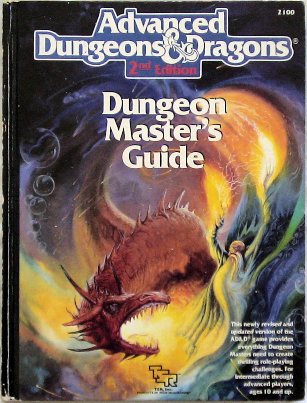 Dungeons and Dragons.
 Books.


